
This video goes over the basic pup tent set up for a 10'x 10' BCUSA tarp.
Survival Fishing with Flowers
In this 1st of a 4 part series Jack from The Survival Podcast
http://thesurvivalpodcast.com
takes you survival fishing with a minimalist kit.
Jack's kit in this video consists of...
- A small assortment of snelled hooks
- A cheapo one dollar knife
- A small spool of monofilament line
- A small hank of parachute cord
Survival Shelter Three-Pole Tarp Tepee
If you have a tarp and three poles and the situation allows, make a survival tarp tepee. It is easy and takes very little time to make this survival tepee. It provides protection from the elements and can act as a signaling device by enhancing a small amount of light from a fire or candle. It is large enough to hold several people and their equipment and to allow sleeping, cooking, and storing firewood.
You can make this tepee, you need three poles 3.5 to 4.5 meters long and about 5 centimeters in diameter.
To make this tepee (See Figure Below)--
- Lay the poles on the ground and lash them together at one end.
- Stand the framework up and spread the poles to form a tripod.
- For more support, place additional poles against the tripod. Five or six additional poles work best, but do not lash them to the tripod.
- Determine the wind direction and locate the entrance 90 degrees or more from the mean wind direction.
- Lay out the tarp on the "backside" of the tripod
- Place the tarp over the top of a free-standing pole.
- Then place the pole back up against the tripod so that the tarp is at the same height as the lashing on the three poles.
- Wrap the tarp around one side of the tripod.
- The canopy should be of double thickness, as you are wrapping an entire tarp.
- You need only wrap half of the tripod, as the remainder of the tarp will encircle the tripod in the opposite direction.
- Construct the entrance by wrapping the folded edges of the tarp around two free-standing poles.
- You can then place the poles side by side to close the tepee's entrance.
- Place all extra tarp underneath the tepee poles and inside to create a floor for the shelter.
- Leave a 30- to 50-centimeter opening at the top for ventilation if you intend to have a fire inside the tepee.

Another center support survival shelter is a Ponch Tent A-Frame set outside but over the center of the tent (Below). Use two 90- to 120-centimeter-long sticks, one with a forked end, to form the A-frame. Tie the hood's drawstring to the A-frame to support the center of the tent.

When TSHTF, one of your top concerns will be finding enough food to sustain you until regular food distribution channels get back up and running. Here's where to find the food you need:
- The food you have stored in your house.
- The food you have stored in your car and other locations (ie: bug out shelter)
- The food in your office.
- The food in other offices in your building/neighborhood/city (bring a crowbar).
- The food running around near your home (squirrel, possum, rabbits, etc).
- The wild food you can gather (berries, cat tails, apples, nuts, etc).
- The larger food in the forest (deer, elk, bear, etc).
- Larger food on local ranches (pig, goat, cow, etc).
- Food in water near your home (fish, shellfish, seaweed, etc).
- Food on local farms (vegetables, grains, fruit, etc).
- Food in grocery stores.
- Food in warehouses/cold storage warehouses.
- Food in institutions (ie: food banks, schools, hospitals, etc).
- Food in local restaurants.
- Food in vacation homes and homes where people have left.
- Food in your yard (dandelions, vegetables and fruit you have grown, etc.).
- Food on the way to its destination (shipping containers, refrigerated trucks, etc).
- Food you can create (quick growing vegies and meat supplies).
- Food provided by relief organizations.
- Food that any other day you wouldn't consider food (rats, bugs, pigeon, etc).
- Food you can have brought in (ie: a contact from an area not hit that could bring you supplies).
- Food that others may overlook (honey from bees, maple syrup from trees, snakes, etc).
- Food that takes concerted effort/materials/equipment to get (ie: whale, other deep sea fish, mountain goat, etc).
- Food that freegans would love (search dumpsters, garbage cans, garbage dumps, etc).
- Food that isn't people food (dog food, cat food, animal food stored in grain silos, etc).

Clean drinking water in 6 hours
The SODIS method is ideal for treating water for drinking in developing countries. All it requires is sunlight and PET bottles. How does it work? Clear PET bottles are filled with the water and set out in the sun for 6 hours. The UV-A rays in sunlight kill germs such as viruses, bacteria and parasites (giardia and cryptosporidia). The method also works when air and water temperatures are low.
People can use the SODIS method to treat their drinking water themselves. The method is very simple and its application is safe. It is particularly suitable for treating relatively small quantities of drinking water.
Research
Many scientific studies confirmed the effectiveness of the SODIS method. It kills germs in water very efficiently. The method has even been shown to improve the health of the population. Research into training strategies gave insight about which communication methods are most suitable. It has also been proven that the use of PET bottles in the SODIS method is harmless.
Survival Skills Make Fire with a AA battery and a staple
0 comments Posted by Bushcraft and Survival Skills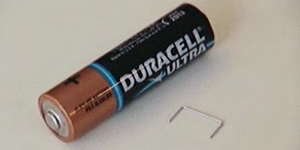
 Subscribe


