
Survival - Become a Survivor in the Wild
Learn to become a true survivor in the wild as this amazing guide teaches invaluable skills against the Seven Enemies that threaten your life. Highly recommended by Sean McBride, Ex-Australian Green Beret Army Special Forces and founder of Touch the Wild survival school, this must-have program includes life-saving tips, practical survival skills and other priceless information that can save your life out in the wild!
Labels: Survival, Survivalist, Survivor
10 SHTF Preppers Communications
Top 10 SHTF Communications. Comms are vital in an emergency situation and Cell phones could be shut down in certain situations.
- Cell Phone
- Multi-Band Scanner
- AM/FM Radio
- Weather Radio
- Shortwave Radio
- FRS Radios
- GMRS Radios
- CB Radios
- Marine
- Ham / Amateur Radio
Tags: SHTF, Communications, Comms, Prepper, Survival, Survivalist, Doomsday Preppers
Labels: Comms, Communications, Doomsday Preppers, Prepper, SHTF, Survival, Survivalist
Preppers are going to die...
Preppers are going to die...
In this video, I pull no punches because I care enough about you to tell you just how it is. I realize I may lose some subscribers but that's not what it's about to me, it's about doing the right thing, about living my values and about trying to help. I can't help unless I speak up about something that is really out of line here in the community.
If I'm wrong, tell me where. If I'm right, you have a choice to make. I hope this 4th of July is a turning point for so many of you.
Tags: WROL BUGOUT SHTF Preparedness Prepper Preppers survival survivalism TEOTWAKWI
Labels: Disaster Preparedness, Preppers, SHTF, SHTF Scenario, Survival, Survivalism, Survivalists
Survival Fishing Hook Made From a Pop Top
Tags: Survival Fish Hook Beverage Can Fishing Bushcraft Wilderness Survival Survival Skills Camping TEOTWAWKI SHTF WROL
Labels: Food Procurement, SHTF, Survival, Survival Fishing, Survival Skills
ARE YOU PREPARED?
In history there are events which stand as milestones marking points of no return. Usually, however such moments are only visible in hind sight.
Via:
https://twitter.com/collapseupdates
Labels: SHTF, SHTF Scenario
"Depicts techniques of personal and equipment camouflage for survival in enemy territory. Shows different types of camouflage and shelters in jungle, desert and arctic environments. Explains how to find or construct obscure hiding places and points out areas to be avoided. Discusses restrictions on campfires."
Military camouflage refers to any method used to render military forces less detectable to enemy forces . In practice, it is the application of colour and materials to battledress and military equipment to conceal them from visual observation. The French slang word camouflage came into common English usage during World War I when the concept of visual deception developed into an essential part of modern military tactics. In that war, long-range artillery and observation by air combined to expand the field of fire, and camouflage was widely used to decrease the danger of being targeted.
Previously known as concealing coloration or deceptive concealment, military camouflage was first practised in the early 1800s by some military units in self-defence against the increased accuracy and rate of fire of guns. Before that, armies tended to wear bright colours and bold, impressive designs to daunt the enemy, foster unit cohesion, allow easier identification of units in the fog of war, attract recruits, and reduce desertion.
The intent of camouflage is to disrupt an outline by merging it with its surroundings, making a target harder to identify, or to confuse an observer as to its nature. Some modern camouflage, e.g. CADPAT, addresses visibility in the near infrared as well as visible light, for concealment from night vision devices. Different countries have taken different paths towards the development of military camouflage...
History
United Kingdom
The first regular units to adopt camouflage colours were the 95th Rifle Regiment and the 60th Rifle Regiment, created during the Napoleonic Wars to strengthen the British skirmish line. As they carried more accurate Baker Rifles and engaged at a longer range, they were dressed in a rifle green jacket, in contrast to the Line regiments' scarlet tunics.
British forces during the mutiny of 1857 in India dyed their white drill uniforms to inconspicuous tones (following the practice started by the Corps of Guides in 1846), called khaki (from the Hindi-Urdu word for "dusty"), by immersion in mud, tea, coffee or coloured inks. The resulting hue varied from dark or slate grey through light brown to off-white, or sometimes even lavender. This improvised measure gradually became widespread among the troops stationed in India and North-West Frontier, and sometimes among the troops campaigning on the African continent. Khaki-coloured uniform became standard service dress for both British and British Indian Army troops stationed in British India in 1885, and in 1896 khaki drill uniform was adopted by British Army for the service outside of Europe in general, but not until the Second Boer War, in 1902, did the entire British Army standardise on khaki (officially known as "drab") for Service Dress.
The Lovat Scouts were formed from Scottish gamekeepers for service in the Boer war. They introduced the Ghillie suit for concealment for sniping in World War I.
Winston Churchill (First Lord of the Admiralty in WWI, Prime Minister in WWII) considered deception in war to be an indispensable "element of léger de main, an original and sinister touch, which leaves the enemy puzzled as well as beaten."
Other nations
The United States, who had green-jacketed rifle units in the Civil War, were quick to follow the British, going khaki in the same year. Russia followed, partially, in 1908. The Italian Army used grigio-verde ("grey-green") in the Alps from 1906 and across the army from 1909. The Germans adopted feldgrau ("field grey") in 1910. Portugal, during the Peninsular War, fielded light infantry known as Cacadores who wore brown-jackets which helped conceal them...
Labels: Camo, Camouflage, SERE, Survival
Quotes and Sayings gathered form around the web for Preppers about Preparing, Preparedness, and Self-Reliance.
Let us be in a position so we are able to not only feed ourselves through home production and storage, but others as well
-- Ezra Taft Benson, former U.S. Secretary of Agriculture
It wasn't raining when Noah built the ark.
-- Howard Ruff
By failing to prepare you are preparing to fail.
-- Ben Franklin
Be prepared.
-- Boy Scout Motto
Be prepared, self-reliant, and independent. Times of plenty are times to live providently and lay up in store. Times of scarcity are times to live frugally and draw on those stores.
-- Bishop Keith B. McMullin, (Ensign, Nov. 2002, p 96)
But if any provide not for his own, and specially for those of his own house, he hath denied the faith, and is worse than an infidel.
-- 1 Timothy 5:8
Do not rely on the government for anything, especially your survival.
-- Fr. Frog
If ye are prepared ye shall not fear.
-- Doctrine & Covenants 38:30
Learn to sustain yourselves; lay up grain and flour, and save it against a day of scarcity.
-- Brigham Young (Discourses of Brigham Young, p 293)
Preparation through education is less costly than learning through tragedy.
-- Max Mayfield, Director National Hurricane Center
Preparedness, when properly pursued, is a way of life, not a sudden, spectacular program.
-- Spencer W. Kimball, 1976
Remember; when disaster strikes, the time to prepare has passed.
-- Steven Cyros
Self-Reliance is a prerequisite to the complete freedom to act.
-- Marion G. Romney, 1984
The only thing more terrifying than an emergency is actually living off the food you have stored! Your food storage should be food you would rotate into your daily diet.
-- Author Unknown
You are responsible for what happens to you.
-- Fr. Frog
You won't have trouble if you are prepared for it.
-- Fr. Frog
Make preparations in advance ... you never have trouble if you are prepared for it.
-- Theodore Roosevelt
Do what you can with what you've got wherever you are.
-- Theodore Roosevelt
The time to repair the roof is when the sun is shining.
-- John F. Kennedy
If I had eight hours to chop down a tree, I'd spend six sharpening my axe.
-- Abraham Lincoln
Go to the ant, O sluggard; consider her ways, and be wise. Without having any chief, officer, or ruler, she prepares her bread in summer and gathers her food in harvest.
-- Proverbs 6:6-8
A prudent man sees danger and takes refuge, but the simple keep going and suffer for it.
-- Proverbs 22:3
Semper paratus - Always prepared
Prepare for the unknown by studying how others in the past have coped with the unforeseeable and the unpredictable.
-- George S. Patton
Expect the best. Prepare for the worst. Capitalize on what comes.
-- Zig Ziglar
Let every head of household see to it that he has on hand enough food and clothing and, where possible, fuel also for at least a year ahead....
-- President J. Rueben Clark, 1937
It is easier to prepare and prevent, than to repair and repent.
-- Anonymous
Preparation at the most individual and household basis is a key to our preparedness. It's important for people to have some water. It's important for people to have a storage of food. It's a good idea to have a first aid kid. What would happen in a pandemic if suddenly trucks couldn't drive and the 24 hour grocery story had no food.
-- Michael Leavitt
Emergency preparedness is a team sport.
-- Eric Whitaker
Despair is most often the offspring of ill-preparedness
-- Don Williams, Jr
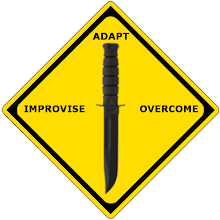
Improvise, Adapt, Overcome
If you liked these, you may also like: Bushcraft, Survival & Nature Quotes
If you know of any more, please feel free to post them in the comment section!
Labels: Disaster Preparedness, Preparing, Prepper, Preppers, Quotes, Self-Reliance
Survival Training US Navy Living Off The Land 1955
1 comments Posted by Bushcraft and Survival Skills"Survival in the North Temperate Regions: Living Off The Land"
US Navy training film aimed at downed pilots telling how to hunt or harvest and prepare food, including animals, plants, fruits, berries, and nuts, between 45 degrees and 70 degrees north latitude (although much of the advice would apply anywhere).
"How to survive under emergency conditions in the north temperate regions."
After water, man's most urgent requirement is food. In contemplating virtually any hypothetical survival situation, the mind immediately turns to thoughts of food. Unless the situation occurs in an arid environment, even water, which is more important to maintaining body functions, will almost always follow food in our initial thoughts. The survivor must remember that the three essentials of survival--water, food, and shelter--are prioritized according to the estimate of the actual situation. This estimate must not only be timely but accurate as well. Some situations may well dictate that shelter precede both food and water.
ANIMALS FOR FOOD
Unless you have the chance to take large game, concentrate your efforts on the smaller animals, due to their abundance. The smaller animal species are also easier to prepare. You must not know all the animal species that are suitable as food. Relatively few are poisonous, and they make a smaller list to
remember. What is important is to learn the habits and behavioral patterns of classes of animals. For example, animals that are excellent choices for trapping, those that inhabit a particular range and occupy a den or nest, those that have somewhat fixed feeding areas, and those that have trails leading from one area to another. Larger, herding animals, such as elk or caribou, roam vast areas and are somewhat more difficult to trap. Also, you must understand the food choices of a particular species.
You can, with relatively few exceptions, eat anything that crawls, swims, walks, or flies. The first obstacle is overcoming your natural aversion to a particular food source. Historically, people in starvation situations have resorted to eating everything imaginable for nourishment. A person who ignores an otherwise healthy food source due to a personal bias, or because he feels it is unappetizing, is risking his own survival. Although it may prove difficult at first, a survivor must eat what is available to maintain his health...
BIRDS
All species of birds are edible, although the flavor will vary considerably. You may skin fish-eating birds to improve their taste. As with any wild animal, you must understand birds' common habits to have a realistic chance of capturing them. You can take pigeons, as well as some other species, from their roost at night by hand. During the nesting season, some species will not leave the nest even when approached. Knowing where and when the birds nest makes catching them easier. Birds tend to have regular flyways going from the roost to a feeding area, to water, and so forth. Careful observation should reveal where these flyways are and indicate good areas for catching birds in nets stretched across the flyways. Roosting sites and waterholes are some of the most promising areas for trapping or snaring.
Nesting birds present another food source--eggs. Remove all but two or three eggs from the clutch, marking the ones that you leave. The bird will continue to lay more eggs to fill the clutch. Continue removing the fresh eggs, leaving the ones you marked.
MAMMALS
Mammals are excellent protein sources and, for Americans, the most tasty food source. There are some drawbacks to obtaining mammals. In a hostile environment, the enemy may detect any traps or snares placed on land. The amount of injury an animal can inflict is in direct proportion to its size. All mammals have teeth and nearly all will bite in self-defense. Even a squirrel can inflict a serious wound and any bite presents a serious risk of infection. Also, a mother can be extremely aggressive in defense of her young.
Any animal with no route of escape will fight when cornered. All mammals are edible; however, the polar bear and bearded seal have toxic levels of vitamin A in their livers. The platypus, native to Australia and Tasmania, is an egg-laying, semi-aquatic mammal that has poisonous glands. Scavenging mammals, such as the opossum, may carry diseases.
US Navy training, survival training film, survival, food, survival cooking, survival hunting, survival trapping, harvesting, survival food, wild edible plants,
Doomsday Preppers Preview Nine Meals Away from Anarchy
10 comments Posted by Bushcraft and Survival SkillsDoomsday Preppers Preview for "Nine Meals Away from Anarchy"
I have been asked by National Geographic's Doomsday Preppers to do a preview for the upcoming episode "Nine Meals Away from Anarchy" which will air on TUE MAR 6 2012 @ 9P et/pt.
Upon receiving the preview DVD and watching it with a fellow "Survivalist", I have to say we were both taken back by a few of the "preppers" on this episode, while I have been asked not to go into too much detail as not to spoil the episode, I will give some thoughts on the 3 preppers that were presented on the show.
The 1st presented I will call him the "bug in guy", he was probably the most well rounded in forethought in his preps and his defense plans.
However, there were a few things that bothered me, first and foremost is OPSEC! (Operational Security). Lets just say he lives in a well to do area, and unless the show used props and not the real location, where he is could be easily located, especially from the local residents in the area.
Although he does have his trained guard dogs, he and his family are training in the use of fire arms, and they do have an ample cache of food and ammo... if an individual or group wanted what they have, there are many ways relieve them of their supplies, some without firing a single shot, which I will not go into here.
Which brings me to what I will call a "fatal flaw". From what I can gather they do not have a contingency plan to bug out if they were forced to evacuate their premises for what ever reason. To be quite honest most in the family looked like they could not walk 10 miles with a 50 pound pack, sorry to be so critical here, but this is real world "survival" we are talking about here, is it not?
The second guy I will call the "Seed Guy". All I could do is shake my head and face palm! His big concern was nuclear fallout from the Fukushima disaster, while this is a very real threat and I am in no way down playing it, it is not the scope of this post.
In general his plan is to gather heirloom seeds, lots of them, and grow them in small green houses made from plastic or canvas from what I could tell. Its is obvious he does not have a basic understanding of the different types and aspects of radioactive particles.
His plan was to bug out with all his seeds, some firearms, and a few of his buddies, Really? So much wrong here, but I think with this guy his lack of critical thinking skills are demonstrated in how he responds to a craigslist ad.
The last guy, I will call him the "Under Ground Bunker Guy", while I could go into great detail here about him, I will just say he has not taken the time to think things all the way through, the distance, inhospitable terrain, he and his young family would have to face would be insurmountable to reach his bunker if they they had no access to an automobile, and his solution to this is his "push cart" Lots wrong here! You be the judge when you see it.
The other thing I might mention is the very reason he is prepping is for a physical pole shift, an under ground bunker on the side of a mountain is the last place I would like to be, as an impending earthquake from such a pole shift could very well turn that bunker into their tomb.
I will also mention, that no one in this episode demonstrated any basic survival skills on how to procure water, food, or shelter using non conventional methods and sources, which is what this blog is all about. Although, to be fair they may have these skills, but they were just not covered in this episode.
Labels: Doomsday Preppers, Preppers
 Subscribe
